Saturday, March 16, 2024

Coin Errors (Part 3) - Planchet Errors

The process of creating a coin begins with a blank metal disc being punched from a metal sheet. This seemingly simple step marks the start of the coin's journey, as it is transformed from a plain piece of metal into a valuable and recognizable form of currency.


Before a blank can be considered ready for coining, it must pass through an upset mill. There the blank is squeezed to a smaller diameter and is simultaneously provided with a low proto-rim at the outer margin of each face. In this way a blank becomes a planchet.


Now let us look at some coin errors which pertain to coin Planchet.

Clipped Planchet (Curved)
Planchet are punched from large thin metal sheets. After a section of the sheet is punched, if the sheet fails to be fed far enough ahead, the punch will overlap an already punched area causing that planchet to have a circular "clip" of missing metal.


Clipped planchet (Straight)
If the metal strip shifts during the punching process and the punches overlap the straight side edge of the strip, a straight area of metal will be missing from the planchet.


Cracked Surface
The phenomenon of a coin developing multiple cracks on its surface, resembling a piece of dry land, is known as the "DROUGHT error." Over time, the lamination of a coin can deteriorate, leading to this unique appearance.


Die Cap
When a coin is struck and sticks to the die for numerous strikes, the metal flows up around the die and the coin takes on the shape of a bottle cap. A very eye appealing and desirable error.


Indent
When a blank planchet partially overlaps another planchet in the striking chamber and gets struck, the overlapping area on the struck coin will exhibit a blank indented area from the other planchet being struck into it.


Lamination
Dirt and impurities in the metal of the planchet can manifest themselves as cracks and peels on the struck coin.


Split Planchet
If the impurity is severe enough, it can case the planchet to split into two halves. If the planchet splits before the strike, the resulting coin will be thin and have detail on both sides but often intermingled with rough striations from the impurities. If the planchet splits after the strike, one side will have full detail and the other side will be blank and striated. In either case the coin will be thin.


Uniface
This is a coin which was struck through another coin, so that no design is present. It is a “100% indent” effectively. This can occur when two planchet are fed into the press at the same time, and they are struck against each other. When struck, one side will be "uniface", which is to say, it will have no design, and the other side will have a very strong strike.


Wrong planchet/off metal
When a planchet is struck by a pair of dies that do not correspond to the denomination intended for the planchet, a wrong planchet error occurs. For example, a Rupee 2 coin struck on a Rupee 1 planchet will have the same weight and composition as a rupee 1.

Wednesday, March 13, 2024

Coin Errors (Part 2) - Die Errors

Coin dies are the metal tools used to strike coins and create the design on the surface. Errors can occur during the creation or use of these dies, leading to unique and sometimes valuable coins.

Now let us look at some coin errors which pertain to coin dies.

Brockage
Brockage occurs when a mirror image of a coin is struck on a blank. After a struck coin fails to eject, a new blank is fed between the struck coin and the hammer die. The hammer die strikes the second blank leaving its image on one side while pressing the blank against the previously stuck coin which sinks its image into opposite side.


Cud (Die Break)
When a significant part of the edge of the die deteriorates and falls off. The coins struck with this die exhibit a raised blank area on that part of the design. Sometimes called "major die break".


Die Clash/Ghost Error
When the upper die moves downwards to strike a coin when no coin blank is there in between, both the dies strike each other. At this high pressure of the strike, some designs of the obverse die are left on the reverse die in relief and some designs of the reverse die are left on the obverse die in relief. When any fresh blank is minted by those dies, an incused image of some text or design of the obverse die is found on the reverse side of the coin and vice versa also occurs. This type of error is called Die clash error / Ghosting error.


Die Crack
During the minting process, there are instances where a die may develop cracks. These cracks can result in the production of coins known as die crack error coins. Such coins bear the imprint of the cracked die, showcasing either a single crack or multiple cracks.


Edge and Rim Error
Planchet is surrounded by collars when struck to prevent the planchet from flattening and spreading. Edge and rim errors occur when collars are either out of position or are deteriorated. A wire rim occurs when excessive pressure squeezes out metal between the collar and the edge of the die producing an extremely high thin rim. A partial collar occurs when an out-of-position collar leaves a line around the coin which is visible when looking at its edge. A partial collar is sometimes called a railroad rim when a reeded edge coin is involved as the line resembles a rail and the reeds resemble railroad ties.


Filled Die
Filled die or grease filled die errors are actually very common and occur more frequently than you might expect. These errors occur when part of a coin’s design is obscured by grease or other foreign matter on the die’s surface. The rest of the coin strikes up, but a selected section does not.

 
Mule
A mismatched set of dies that struck a coin. Mule errors can be two different designs of the same series of coin, or of a difference series of coin matched together. It can even be a foreign coin die matched with a domestic coin die.


Wrong Collar
A reeded edge is produced by a reeded or grooved collar; the reeding on a coin is created at the same instant the piece is struck by a pair of dies. When struck, metal of the blank fills every cavity of both obverse and reverse die, it also expands between the dies up against the reeded collar filling every indentation and forming the knurls and flutes. This error occurs when wrong collar is used. e.g., plain collar is used instead of reeded collar or vice versa.

Tuesday, March 12, 2024

Coin Errors (Part 1) - Introduction

Error coins are a fascinating aspect of numismatics, with each one telling a unique story of a mistake made during the coin manufacturing process. These coins can exhibit a variety of issues, from being struck off-center to having the wrong planchet type or thickness.

One common cause of error coins is damage to the coin die, which can result in multiple coins being produced with the same error. Whether the die is cracked from overuse or was not made correctly in the first place, these mistakes can lead to a range of interesting and valuable error coins entering circulation.

Classification of Error Coins
There are three different classifications of error coins. Some error coins may have a combination of these problems.

Die:
A coin die is a hardened piece of metal that is used to strike the coins in the coining press. Any coin die that is not made in adherence to Mint standards. This may include preproduction errors and damage to the coin die during the coining process.

Planchet:
Any problem with the planchet that the coin was made on. This may include incomplete planchet, wrong metal, cracked, chipped, clipped, or thickness.

Strike:
Any problem with the physical production of the coin in the coining press. There is numerous classifications of errors that are due to the improper striking of a coin. Examples include off-center strikes, multiple strikes, rotated dies, misaligned dies, weak strikes, overstrikes, etc.

Friday, March 08, 2024

Die Cap and Brockage Coin

When you find a coin that looks like it could be an error, the first question you must ask is whether the error occurred at the mint, or after the coin left the mint. Coins with errors at the mint are valuable.

The minting of coins in today's world has evolved into a complex and technologically advanced process. However, as its core, the process remains relatively simple. A blank metal piece, known as planchet, is placed between two hammers with reverse engraved images of the coin, called dies, on their ends. When pressure is applied to both sides of the planchet through hammers, the design from the dies transfers onto the metal, transforming it into a coin.


In the realm of minting processes, even with the utilization of sophisticated technologies and rigorous quality control measures, errors can still manifest, which can range from die errors, planchet errors to striking errors.

A Die Cap occurs when a coin that has been struck sticks to the upper hammer die during the minting process. Once the coin is stuck to the die face, the reverse side of the coin that was struck becomes the new die face for the next coin to be minted.

As the next blank is fed into the collar and the strike takes place, the reverse design of the previously adhered coin is transferred onto the new blank, resulting in what is known as a Brockage strike.

The coin that adhered to the upper die and caused the initial die cap is referred to as a die cap, and this process continues as more coins are minted using the same die cap. With each subsequent strike, the cap metal is pushed further around the upper die shaft, and over time, the cap breaks away from the die in the shape of a thimble.


Tuesday, March 05, 2024

Varieties of UN 50th Anniversary Coin (1995)

In 1995, on the 50th anniversary of the United Nations (1945 - 1995), SBP issued a commemorative Bronze coin in the denomination of Rupees 5 with a diameter of 35.25mm and weight of 20g.

In recent years, collectors on various social media platforms have reported noticing variations in the design of this coin. To date, seven or eight different varieties have been discovered.

The discovery of these variations has led to speculation about the possible reasons behind them. Some believe that they may be the result of errors in the minting process, while others suggest that they could be intentional design changes made by the mint.

Regardless of the cause, the existence of these variations adds a new layer of complexity and intrigue to the world of coin collecting. Collectors are now on the lookout for these rare and unique coins, hoping to add them to their collections.

The discovery of various varieties of this coin has sparked my interest and excitement to delve deeper into numismatics. Upon closely examining multiple coins, I found out that there are two major die varieties (obverse and reverse both) of this coin on which the coins were minted.


When comparing Die Variety 1 and Die Variety 2, one significant difference apart from the date is the size of the objects on the obverse side. In Die Variety 2, the objects appear larger, giving the impression that the entire front image of the coin has been enlarged. This alteration in size between the two die varieties is a notable distinction that sets them apart.


The reverse side of both varieties of the coin exhibit a subtle difference in the tail of the digit 5. In Die Variety 1, the tail of the digit 5 is shorter, while in Die Variety 2, it is longer. 

Some collectors also noticed variations in the date, in some coins a particular digit is smaller from the rest while in some cases a particular digit is larger from the rest. I think this happens due to deposits of the metal particles on the die in the mintage run.

The combination of two dies and date variations in this coin can result in a wide range of varieties. However, in my opinion, the major varieties of these coins can be narrowed down to two distinct types. 

Saturday, March 02, 2024

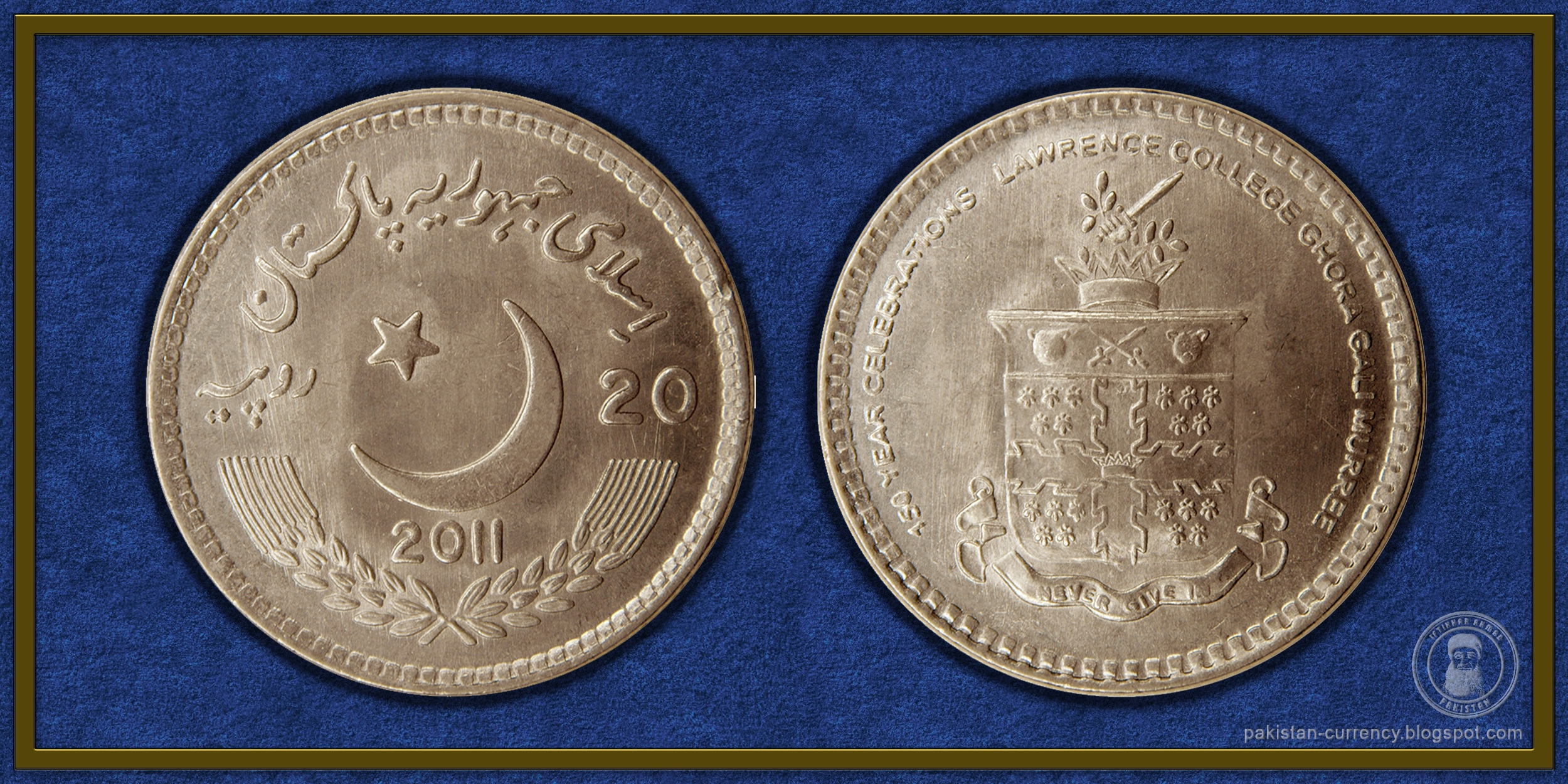
Error in the logo design of Lawrence College Coin (2011)

In 2011, on the 150 year Celebrations of Lawrence College, Ghora Gali, Murree, SBP issued a commemorative coin in the denomination of Rs. 20.


Upon closer examination of the coin, it has been discovered that the design of the Lawrence College logo engraved on the reverse side of the coin differs from the actual logo.

Friday, March 01, 2024

2 Varieties of Guru Nanak Dev Ji Coin (2019)

In 2019, on the 550th birth anniversary of Guru Nanak Dev Ji (Founder of Sikhism and the first of the ten Sikh Gurus), SBP issued a commemorative coin in the denomination of Rupees 550.

With a slight variation two variants of this coin exists.


Wednesday, February 28, 2024

2 Varieties of Benazir Bhutto Shaheed Coin (2008)

In 2008, on the 1st death anniversary of Mohtarma Benzair Bhutto Shaheed, SBP issued a commemorative coin in the denomination of Rupees 10.

With a slight variation two variants of the coin exists.

Monday, February 26, 2024

No Izafat on Quaid-i-Azam Birth Centenary Coins

Urdu has a special construction derived from Persian called “Izafat”.  Izafat links two words, either two nouns, or a noun and an adjective.  Izafat is indicated by a “zair” under the last letter of the first word.  It is pronounced “ay” and usually transliterated as “-e-“.

When Izafat links two nouns, it means “of”.  Here’s an example of Izafat linking two nouns:

Government of Pakistan used this Izafat on its name for all its coins (regular or commemorative) issued from 1974 to 1997.


But it is interesting to note that all the three coins (50 Paisa, 100 Rupees and 500 Rupees) issued to mark the Birth Centenary of Quaid-i-Azam does not contain this Izafat.


Missing of this Izafat removes of from the transliteration (Government of Pakistan) and the word became Government Pakistan.

This Izafat is also missing from the word Quaid-e-Azam on the Rs. 100 Coin.

50 Paisa coin was issued on Dec 22, 1976 and was minted by Pakistan Mint, Lahore, whereas the Rs 100 and Rs 500 coins were issued on Feb 22, 1977 and were minted by Italcambio Mint, Venezuela.

Thursday, February 22, 2024

Hakumat or Hukumat

From the beginning, coin issuing and controlling have been the responsibility of the Government of Pakistan, and the name 'Government of Pakistan' has been a prominent feature of the issued coins. From 1948 to 1961, the name Government of Pakistan was inscribed in two languages: English and Urdu. While the name in English was inscribed in a simple font, the name in Urdu is in the form of a Tughra.

As government is translated to 'Hakumat' in Urdu, the text inscribed was ‘Hakumat-e-Pakistan’. In 1964, the name in English was replaced with the name in Bengali. The Urdu one remains the same.


After the creation of Bangladesh, the name in Bengali was dropped, and from 1974 onwards, only the name in Urdu was inscribed. The design was changed from Tughra to a simpler font.


If it were only a matter of translation, it would have been great, but they decided to include aeraab (marks that represent the short vowel sounds of a, i, and u when used above or below other letters in any word) to make the name fancy. Now, if you want to add aeraab to any word in Urdu, you have to find out the root of the word for the correct pronunciation.

The word ‘Hukumat’ is borrowed from the Arabic language. And Arabic has three words with the same alphabets but different aeraab, sounds, and meanings.

حَكَم means judge, arbitrator

حُكْم means authority, government

حِكَم means wisdom, knowledge

Initially, it was thought that the root of the word Hukumat was the first one, so they put Zabr (a tiny slash that produces the sound of ‘A’) above the first alphabet. Coins of all denominations (1, 2, 5, 10, 25, and 50 paisa) from 1974 to early 1976 have this text.

Then someone realized that the root of the word Hukumat was not the first one but the second one, which means government, so they changed the aeraab and put Pesh (a little circle with a tail that produces the sound of ‘O’) above the first alphabet. Coins from late 1976 to 1990s have this text.