Friday, November 27, 2015

Pattern Coins

Pattern Coin is a coin which has not been approved for release, produced for the purpose of evaluating a proposed coin design. They are often off-metal strike, to proof standard or piedforts. They are collected or studied by many coin collectors because of their sometimes highly elaborate designs.

In Pakistan Mint’s history, they are consistently producing prototype or “pattern” coins to test various designs, metals, formats and techniques. Some examples of Pakistan Pattern Coins are

       3 Paisa (1966)                             1 Paisa Bronze (1967)

  5 Paisa Aluminum (1971)              1 Rupee Nickel Brass (1991)

5 Paisa ND

    10 Paisa ND                                      50 Paisa ND  

1 Rupee Bronze (1995)                    50 Rupees Bronze (1995)

    5 Rupees Silver (1995)                5 Rupees Silver Double Strike

5 Rupees Pattern (1995)                    5 Rupees Pattern (1995)

50 Rupees Pattern (1997)                 50 Rupees Bronze (1997)

50 Rupees Pattern (1997)

25 Paisa Aluminum (1998)                   50 Paisa Brass (1998)    

 
5 Rupees Pattern (2001)                   5 Rupees Pattern (2001) 

 5 Rupees Pattern (2001)                   5 Rupees Pattern (2001) 

 5 Rupees Pattern (2001)                   5 Rupees Pattern (2001) 

 5 Rupees Pattern (2001)                   5 Rupees Pattern (2001) 

      5 Rupees Copper (2002)              5 Rupees Copper Zinc (2002) 

10 Rupees Bronze (2003)

  10 Rupees Bronze (2008)                  10 Rupees Brass (2008)    

Wednesday, November 25, 2015

Proof Coins - What are they ?

Uncirculated Coin
Uncirculated means a coin has not had any wear, such as the wear a coin might experience when it is used in commerce. Handling a coin, as well as improperly storing a coin, can result in wear on the surface of the coin.  This wear, even if very minor, will cause a coin to no longer grade uncirculated. 

When coins are minted they often bump into each other and receive small nicks and abrasion marks during the production process. These marks also occur as coins are transported in large canvas bags.  These marks, sometimes called "bag marks", are more noticeable on larger coins.

An uncirculated coin may show tarnish, toning, spotting, or discoloration and still remain in uncirculated condition.  Experts recommend you "never clean a tarnished coin", because most cleaning will cause wear on a coin, and thus lower its grade.


Proof Coin
A newly minted proof coin is also Un-circulated, however it is the way it is made that causes a difference in appearance and qualifies it as a "proof".  To understand this, let's look at how coins are made.  Coins are produced when two dies strike a blank piece of metal with tremendous force. One die is engraved with the front (obverse) design for the coin.  The other die has the back (reverse) coin design on it. 

By treating the die in a special way, the coins it produces have a different appearance.  Modern technology allows the high points on the coin design to be acid treated (on the die).  The background (field) design of the coin die is polished, resulting in a mirror-like look on the coin it strikes. This gives the finished coin a frosted look (frosting) on the raise parts of the design, with a mirror like finish on the background. This contrasting finish is often called "cameo". 

Not only are proofs made using specially treated dies, each coin is struck two or more times by the coin die. By striking it more than once the metal is forced into all the crevices of the die, thereby giving a very fine detail to the image on the coin.  This fine detail does not appear on some non-proof coins.   


Cameo Effect
The cameo effect on a proof coin is produced by the field having a mirror-like surface and the coin's devices having a frosted surface. If there is a dramatic contrast between the field and the devices, this is referred to as ultra/deep cameo. 
 

Thursday, November 19, 2015

Banknote Posters on SBP website

Rs. 20 Banknote (English and Urdu Posters)

 Rs. 50 Banknote (English and Urdu Posters)

 Rs. 100 Banknote (English and Urdu Posters)

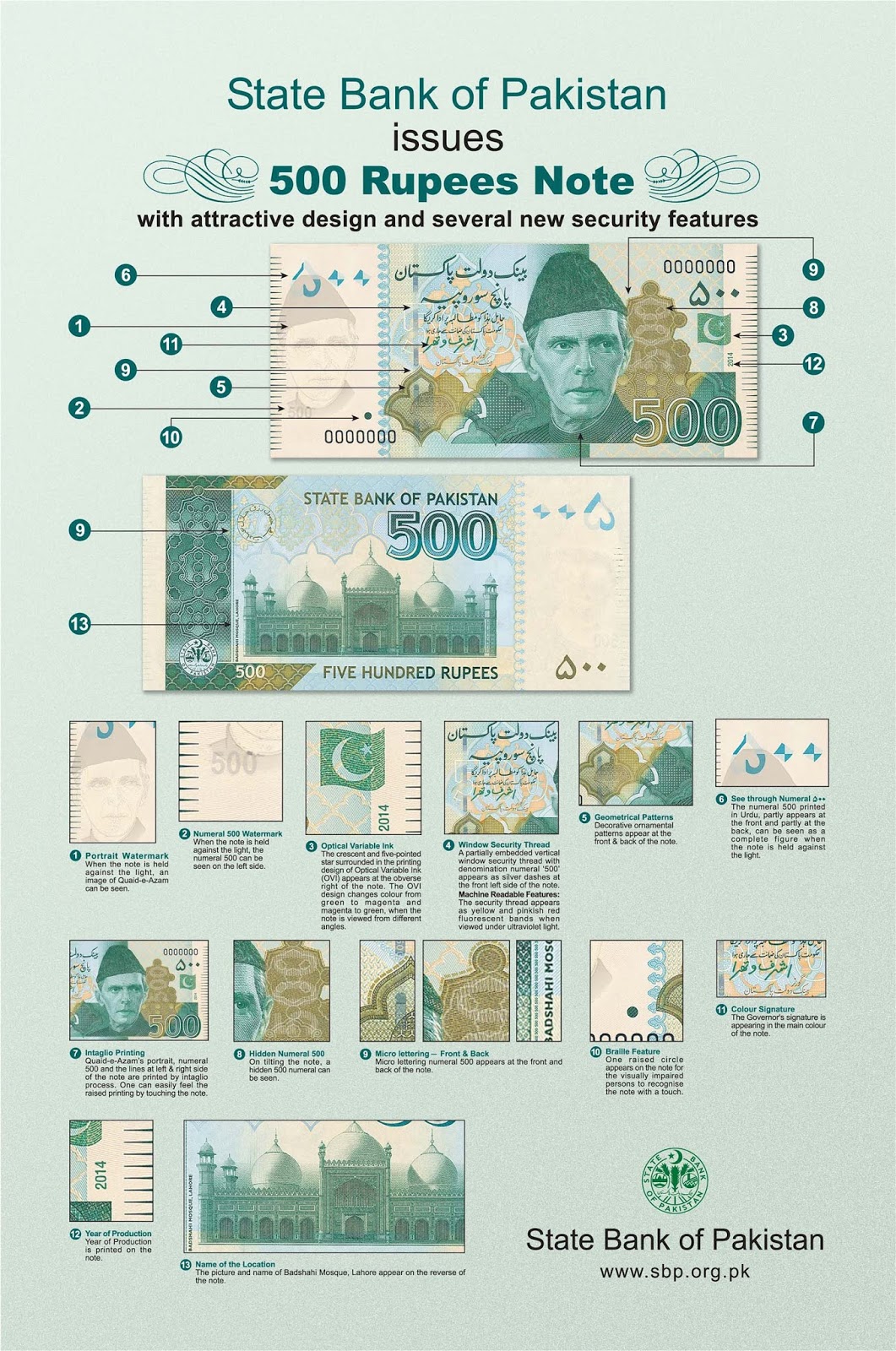
 Rs. 500 Banknote (English and Urdu Posters)

 Rs. 1000 Banknote (English and Urdu Posters)

 Rs. 5000 Banknote (English and Urdu Posters)


Courtesy State Bank of Pakistan (www.sbp.org.pk)

Monday, November 02, 2015

"Pakistan Note Payment Refused"

After the partition of Indian sub-continent into Pakistan and India in 1947, British India banknotes were used in the newly created country of Pakistan.  For emergency use, in the absence of a Bank of Pakistan to dictate monetary policy, the Reserve Bank of India overprinted “Government of Pakistan” on banknotes for circulation in Pakistan. 

Shown below is a 10 Rupees banknote From British India before the partition and with the stamp of the new Government of Pakistan.


Some of these banknotes made its way back into India at the time of the partition.  Resourceful Indians tried to use the banknotes by erasing the overprint. When detected by government authorities, they counter marked the banknotes with Pakistan Note, Payment Refused.”  This is one of the rare oddities from the partition of the Indian sub-continent to India and Pakistan.  


Wednesday, October 14, 2015

SBP to Issue Rs. 5 Coin of New Size & Changed Metal Composition

The State Bank of Pakistan will issue Rs. 5 coin of new size and changed metal composition. These coins will be issued through the exchange counters of all the field offices of SBP Banking Services Corporation from 15th October 2015.


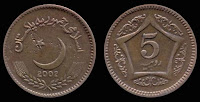
5 Rupees (October 15, 2015)
Dimension - 18.5 mm, Weight - 3 gms
Material - Cupro Nickel (Copper 79%, Zinc 20% & Nickel 1%)

Further, it may be noted that the existing Rs.5/- coin will also be in circulation along with new coin. The existing 5 Rs. coin is 24 mm in diameter weighing 6.5 gms with composition of Copper 75% & Nickel 25%.

Wednesday, September 02, 2015

SBP denies plans to introduce 10,000 Rupee note

According to a SBP (State Bank of Pakistan) press release of August 18th, 2015, SBP "categorically denies the news item reported in a section of press and electronic/social media regarding its plans to issue new banknote of Rs. 10,000/- The SBP has no plans whatsoever for issuance of any higher denomination banknote as seven denominations of existing banknotes are adequately meeting the business/transactional needs of the economy." At present the largest denomination remains the 5,000 rupee note.

Saturday, August 15, 2015

Our Numbering System

The numbering system we use currently to denote numeric values is the Indian Numbering System which is based on the Vedic numbering system in which numbers over 9,999 are written in two-digit groups (or a mix of two- and three-digit groups) rather than the three-digit groups used in most other parts of the world.

In Pakistan we do not use this numbering system in English media but only in Urdu & other regional languages.

Commonly we use Laakh and Carore for Hundred Thousand and Ten Million respectively.  Some of us also know that beyond carore we can use Arab and Kharab, but many of us don't know beyond that. Following is the table of numerical values with their names in Indian Numbering System just for your knowledge.