


Monday, May 27, 2024
Sunday, May 26, 2024

Saturday, May 25, 2024

Thursday, May 23, 2024

Wednesday, May 22, 2024

Friday, May 17, 2024


Wednesday, May 01, 2024

Wednesday, April 10, 2024

Sunday, April 07, 2024
Zakat Calculations 2024
According to Islamic Law…
The Islamic Dinar is a specific weight of 22k gold (917.) equivalent to 4.25 grams, and Dirham is a specific weight of pure silver equivalent to 2.975 grams.

Umar Ibn al-Khattab established the known standard relationship between them based on their weights: “7 dinars must be equivalent to 10 dirhams”.
“The Revelation undertook to mention them and attached many judgments to them, for example Zakat, Marriage and Hudud etc., therefore within the Revelation they have a reality and specific measure for assessment [of Zakat, etc.] upon which its judgment may be based rather than on the non-shari’i coins”.
Know that there is consensus [ijma] since the beginning of Islam and the age of the Companions and the Followers that the dirham of the shari’ah is that of which ten weigh seven mithqals [weight of the dinar] of gold… The weight of a mithqal of gold is seventy-two grains of barley, so that the dirham which is seven-tenths of it is fifty and two-fifths grains. All these measurements are firmly established by consensus. Ibn Khaldum, Al-Muqaddimah.
Zakat
The literal meaning of Zakat is ‘to cleanse’ or ‘purification’. In the Islamic faith, Zakat means purifying your wealth for the will of Allah SWT; to acknowledge that everything we own belongs to Allah SWT and to work towards the betterment of the Muslim Ummah. According to Islamic regulations, Zakat is 2.5% of one year’s total cumulative wealth. This amount is then distributed to the poor. Prophet Mohammad (PBUH) has said “Whoever pays the zakat on his wealth will have its evil removed from him”
Sayyidina Ali ibn Abi Talib (karam-Allah Wajhu) reported that Rasul-Allah (sallallahu alaihi wasallam) said: “There is nothing due upon you in gold, until it reaches twenty dinars. Thus, if you have twenty dinars at the end of the lunar year, then there is half a dinar levied on it [as Zakat] and if you have two hundred dirhams and a year passes, then five dirhams are due upon it. Any additional amount will be calculated in this manner. There is no Zakat on property until it has been owned for one year.” (Hadith related by Ahmad, Abu Dawud, and al-Baihaqi).
0.5 dinar / 20 dinars = 0.5/20 * 100 = 2.5%
5 dirhams / 200 dirhams = 5/200 * 100 = 2.5%
Nisab
To be liable for zakat, one’s wealth must amount to more than a threshold figure, termed the “NISAB”.
Nisab for Zakat (according to Dinar & Dirham concept)
Gold (Rs. 18,091/- per gram as on March 12, 2024)
20 Dinars (20 * 4.25) = 85 grams (85 / 28.3495231) = 2.99828 Oz = 3 Oz
85 * 18,091/- = Rs. 1,537,735/-
Silver (Rs. 223/- per gram as on March 12, 2024)
200 Dirhams (200 * 2.975) = 595 grams (595 / 28.3495231) = 20.9880 Oz = 21 Oz
595 * 223/- = Rs. 132,685/-
Cash
equivalent to gold or silver whichever is less
Nisab for Zakat (according to tola concept)
Early dinars were struck of 4.4 grams of gold and 20 dinars equals to approx. 7.5 Tola, and early dirhams were struck of 3.0615 grams of silver and 200 dirhams equals to approx. 52.5 Tola.
Gold
7.5 Tola (7.5 * 11.6638038) = 87.47 grams (87.47 / 28.3495231) = 3.08 Oz
87.47 * 18,091/- = Rs. 1,582,420/-
Silver
52.5 Tola (52.5 * 11.6638038) = 612.35 grams (612.35 / 28.3495231) = 21.60 Oz
612.35 * 223/- = Rs. 136,554/-
Cash
equivalent to gold or silver whichever is less
Notes
1 Oz = 28.3495231 grams
1 Tola = 11.6638038 grams
Saturday, March 23, 2024
Coin Errors (Part 4) - Strike Errors
Striking a coin refers to pressing an image into the blank metal disc, or planchet, and is a term descended from the days when the dies were struck with hammers to deform the metal into the image of the dies.
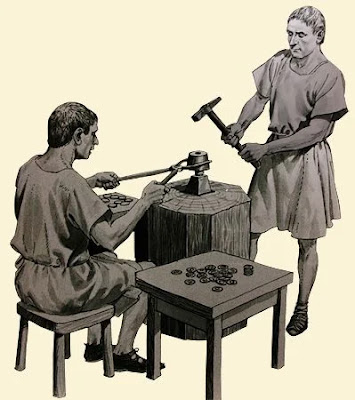
Striking of coins in a coining press can be subject to various errors that result in imperfect strikes. These errors can include off-center strikes, multiple strikes, rotated dies, misaligned dies, weak strikes, overstrikes, and more. Each type of error can impact the appearance and quality of the coin, leading to inconsistencies in design and potentially affecting its value.
Now let us look at some coin errors which pertain to coin Striking.
Broad Strike
Coin struck without a collar, thus when the coin is struck the metal is allowed to expand and increase in diameter. May be centered or un-centered, but must not have any missing lettering or design detail.

Capped Die Strike
When a die cap error is occurring, the dies continue to strike more coins even though a coin is capped around one of the dies. If the coin is capped around the obverse die, the coins stuck with that die will appear blank or have varying degrees of mushiness on the obverse due to the obverse die being obstructed. If the cap stays on indefinitely, eventually it will wear through the planchet and the coins struck by that die will become less and less obstructed causing a "late-stage" capped die strike where the image is less distorted.

Die Axis Rotation
While minting a coin, both the dies are kept in such a position, that the top most design of the obverse and reverse coin exactly face each other. This type of error occurs, when one of the dies is rotated with respect to the other die. In this type of error, the Obverse / Reverse Die is rotated, anywhere from 5-180 degrees clockwise or counterclockwise.

Double Denomination
Occurs when an already struck coin is struck by a pair of dies of a different denomination. These coins will show details of both denominations. Usually, the details of the denomination of the last dies to strike to coin are strongest and some double denomination coins barely show any detail from the denomination of the first strike.

Double Strike
If a coin fails to be properly ejected from the striking chamber after being stuck and the dies come down again to strike the coin again, a double strike occurs. Double strikes can occur with the second strike off center or on-center. In the same way triple and multiple struck coins occur.

Machine Doubling
This type of doubling occurs when the die strikes a planchet. If the die is not properly seated, it can move slightly or bounce during the moment of striking, creating a flat, shelf-like doubling. This effect will be different on all coins struck, so it is technically not a variety, but rather more of a striking error.

Off Center
Coin struck without a collar and off center, different from the un-centered broad strike because part of the lettering or design detail is missing.

OverstrikeAn overstrike is a coin which is struck (either deliberately or as a mint error) on a previously struck coin from a different era or country.


Weak strike
Occurs when there is insufficient pressure from the dies to leave a full impression on the planchet. This can occur for a variety of reasons but usually occurs when the power to the presses is turned off and the dies continue to strike coins with less and less pressure until coming to a stop. If the coin is simply struck through grease, some details may be strong and the edge reading will also be strong.


Striking of coins in a coining press can be subject to various errors that result in imperfect strikes. These errors can include off-center strikes, multiple strikes, rotated dies, misaligned dies, weak strikes, overstrikes, and more. Each type of error can impact the appearance and quality of the coin, leading to inconsistencies in design and potentially affecting its value.
Now let us look at some coin errors which pertain to coin Striking.
Broad Strike
Coin struck without a collar, thus when the coin is struck the metal is allowed to expand and increase in diameter. May be centered or un-centered, but must not have any missing lettering or design detail.

Capped Die Strike
When a die cap error is occurring, the dies continue to strike more coins even though a coin is capped around one of the dies. If the coin is capped around the obverse die, the coins stuck with that die will appear blank or have varying degrees of mushiness on the obverse due to the obverse die being obstructed. If the cap stays on indefinitely, eventually it will wear through the planchet and the coins struck by that die will become less and less obstructed causing a "late-stage" capped die strike where the image is less distorted.

Die Axis Rotation
While minting a coin, both the dies are kept in such a position, that the top most design of the obverse and reverse coin exactly face each other. This type of error occurs, when one of the dies is rotated with respect to the other die. In this type of error, the Obverse / Reverse Die is rotated, anywhere from 5-180 degrees clockwise or counterclockwise.

Double Denomination
Occurs when an already struck coin is struck by a pair of dies of a different denomination. These coins will show details of both denominations. Usually, the details of the denomination of the last dies to strike to coin are strongest and some double denomination coins barely show any detail from the denomination of the first strike.

Double Strike
If a coin fails to be properly ejected from the striking chamber after being stuck and the dies come down again to strike the coin again, a double strike occurs. Double strikes can occur with the second strike off center or on-center. In the same way triple and multiple struck coins occur.

Machine Doubling
This type of doubling occurs when the die strikes a planchet. If the die is not properly seated, it can move slightly or bounce during the moment of striking, creating a flat, shelf-like doubling. This effect will be different on all coins struck, so it is technically not a variety, but rather more of a striking error.

Off Center
Coin struck without a collar and off center, different from the un-centered broad strike because part of the lettering or design detail is missing.

Overstrike

Struck through Error
Occurs when a foreign object lies on top of the planchet and leaves an impression of itself when struck into the coin. A wide variety of objects have been reported including grease, string, cloth, hair, plastic, band-aid, staples, etc.
Occurs when a foreign object lies on top of the planchet and leaves an impression of itself when struck into the coin. A wide variety of objects have been reported including grease, string, cloth, hair, plastic, band-aid, staples, etc.

Weak strike
Occurs when there is insufficient pressure from the dies to leave a full impression on the planchet. This can occur for a variety of reasons but usually occurs when the power to the presses is turned off and the dies continue to strike coins with less and less pressure until coming to a stop. If the coin is simply struck through grease, some details may be strong and the edge reading will also be strong.

Subscribe to:
Posts (Atom)