Sunday, November 08, 2020

Tale of Waxing and Waning Crescent

The national flag of Pakistan symbolizes Pakistan's commitment to Islam and the rights of religious minorities. The green represents the Muslim majority in Pakistan and the white stripe represents religious minorities. The crescent represents progress and the five-pointed star represents light and knowledge. As the Crescent and Star is the most prominent part of Flag, it became the national symbol which can be incorporated in to state issued articles including Postage Stamps, Coins, Currency Notes, Stamp Papers, State Emblem, Government Stationary etc.

Pakistan Flag

To delve into the genesis of the Pakistan flag, the All India Muslim League used the Islamic ‘Subz Hilali Parcham’ meaning ‘green flag with the crescent’, since its inception in 1906, in Dacca.

All India Muslim League Flag

At the All India Muslim League’s Lucknow session in 1937, Mohammad Ali Jinnah pronounced that the League’s green flag – the flag of Islam, to be the national flag for the ‘Land of the Pure’. I feel confident that once they understand and realize the policy and program of the Muslim League, the entire Musalman population of India will rally round its platform and under its flag. So said Mohammad Ali Jinnah in his Presidential address. 

Meeting after 1937 Session

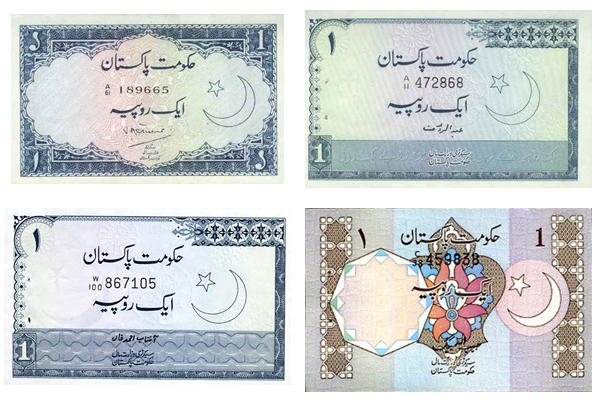
If you look at the crescent in Pakistan’s flag, it is facing the right side which means it’s a waning crescent, but it should be a waxing crescent (facing on the left side) which represents progress and growth. But as the flag is two-sided and always flows from left to right this contention is refutable.

Keeping the flag in mind initial postage stamps, currency notes, and coins issued by the Government of Pakistan contains the same position of crescent and star (facing on the right side).

Postage Stamps (1948) 


Coins (1948)

Currency Notes (1948-49)

But soon it is realized that only a flag can be exempted, for all other things a waxing crescent (facing on the left side) should be implemented. After that postage stamps, currency notes, and coins were redesigned with the implementation of a waxing crescent.

Postage Stamps (1949)

Coins (1950)

Currency Notes (1951 onward)

Even the state emblem of Pakistan which was adopted in 1954 contains the left facing waxing crescent.

State Emblem


Friday, October 09, 2020

Quaid-i-Azam portrait on Pakistan's banknotes

All of us in our life somehow or other dealt with currency notes of Pakistan. Throughout our history different series were issued with different designs and colors, but one thing is common in all of the series (except the RBI Pakistan imprint series, first emergency issue series and the first SBP series), i.e. Portrait of Quaid-i-Azam.

The picture of Quaid-i-Azam used on banknotes was taken by Mr. Arthur Sequeira in the studios of Messrs. I. Sequeira & Sons in Saddar Karachi (where the Atrium Mall stands today) in 1943. It was a black & white photo, colored by studio artists to show his actual attire when he came to the studios for his “Official” photograph.


Following picture was taken on the inauguration of the official photograph of Quaid-i-Azam. The inauguration was done by Begum Ra’ana Liaquat Ali Khan in the presence of the family of Messrs. I. Sequeira & Sons Photographers, Karachi.


Vignette used in Banknotes

This picture was used as the portrait and watermark on banknotes of Pakistan starting from the SBP second series up to sixth series. For the seventh series this picture was modified/altered for the Quaid-i-Azam to be shown wearing a Sherwani.

Tuesday, September 29, 2020

Un-issued Rs. 5 banknote proof of 1970s

This 5 Rupees banknote was never issued. It is probable that this 5 Rupees banknote was part of a complete series that used the theme of the ‘four languages’ throughout their designs; but the plans of the issuing authorities were modified after criticism following the introduction of the 1 Rupee banknote.


Thursday, September 24, 2020

Un-issued Rs. 1000 banknote proof of 1970s

Pakistan, first 1000 Rupees un-issued Proof banknote with picture of Sat Gombuj Mosque (located in Mohammadpur, Dhaka)`at reverse. This note was about to come into the circulation but unfortunately at that time separation movement was started and united Pakistan got divided into 2 countries and this note couldn’t come into the circulation.


Saturday, February 29, 2020

Commemorative Coin - International Conference - 40 Years of Afghan Refugees in Pakistan (40 Rs)

Forty years ago in 1979, the Soviet forces (Now Russia) invaded Afghanistan. It created Soviet-Afghan War, which lasted for 9 years (December 24, 1979 – February 15, 1989). As a consequence, a large number of Afghan refugees crossed the border into Pakistan seeking refuge from the ravages of war. Their influx started through Torkham border as millions of Afghan refugees entered our country. To this day, the security situation in Afghanistan remains unstable.

Throughout these forty years the people of Pakistan have been generously hosting Afghan refugees; making this the largest protracted refugee crisis under the mandate of United Nations High Commissioner for Refugees (UNHCR).

A commemorative coin is issued marking these Forty years of Afghan Refugees in Pakistan.


Tuesday, November 12, 2019

Commemorative Coin - Baba Guru Nanak Sahib (550 Rs)

On the occasion of 550th Birth celebrations of Baba Guru Nanak Sahib the State Bank of Pakistan (SBP) issued a commemorative coin of Rs. 550 on November 12th, 2019 marking the opening of the Kartarpur Corridor for the Sikh pilgrims from India.